
Children’s Books About How A Baby is Made
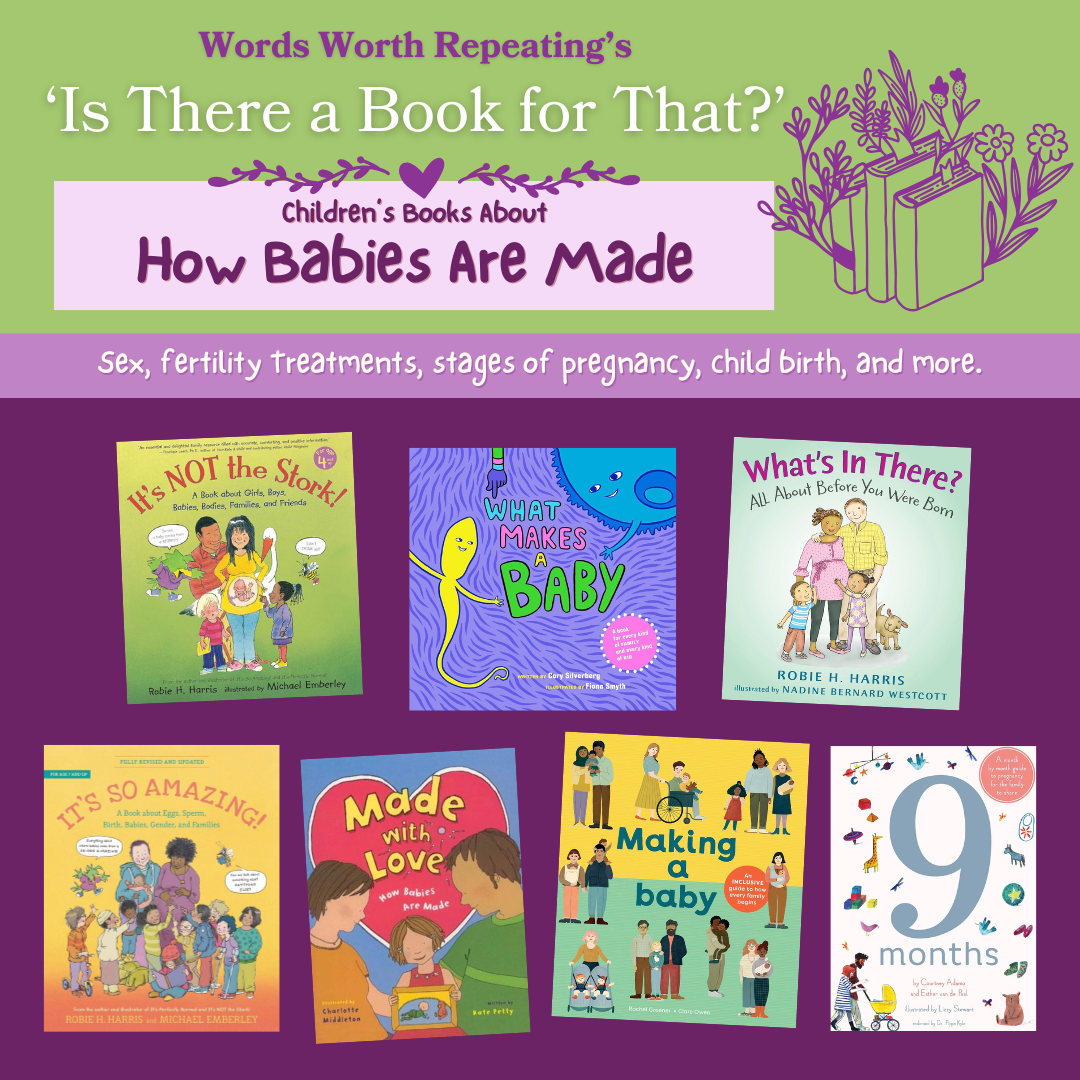
This might the most topic that caregivers bring up as something that they are nervous about explaining to their kids. There are lots of reasons for this (too many for me to get into in this blog!), but thankfully there are several well-written children’s books about these topics. Whether you want to sit down with your child and read them from front to back or have them around for when hard things come up. I had several of them laying around this week as I prepared this blog, and it was interesting to see my kids pick them up and read a few pages here and there.
Below I have several different resources. All of them were written thoughtfully and use honest and scientific language, but you will see that different titles will be good for different families at different times. Some of these books go in to depth about egg/sperm donation and fertility treatments, some are simple and only include “basic babymaking”. some talk about gender over the lifetime, some keep gender completely out of the book, etc. Many of them include genitals in the illustration which I know can feel a little jarring, but can often help kids understand what the book is saying. Some do not, as I know that might limit where you can use the book.
Anyway, I think you can find all of that below. So find one or three that are a good fit for the children in your life, and let’s talk honestly about sex, babies, and all the details! Our kids will be better off for it, and maybe they won’t have so much trouble talking about it with their kids.
Again, I make a small commission on some of the links. You can use them if you are interested in a book and want to support this blog. You can also just use them to get a better look at the book or figure out where you can find it. Thanks for all your support!
It’s Not the Stork! A Book about Girls, Boys, Babies, Bodies, Families, and Friends by Robie H. Haris (baby making in various ways, sperm/eggs, pregnancy, and birth, plus more)
This book is likely best done in sections. The book talks about a wide variety of topics related to baby making and growing using language for younger kids. There is a glossary that can help you jump around or you can start at the front and go all the way through. This book covers the things that are the same and different about a female and a male body, including illustrations. The book talks about adult bodies, sex, brief explanations of fertility treatments, a growing baby, umbilical cord, common pregnancy experiences, twins/multiples, birth (both vaginal and c-section), kinds of families, consent, different kinds of touches, and friends. The book does include pictures of genitals that help kids understand. I appreciate the words used in this book, as it seems like it keeps things simple, but factual. I also appreciate the content as it includes a lot of the topics caregivers want to discuss with their preschoolers-through middle elementary. The book includes a cartoon bird and birth who disagree about how much information they are getting and express their excitement/embarrassment about learning about these things. I appreciate them as a way for adults and kids to acknowledge that kids and adults might be uncomfortable or not with the subject.
https://amzn.to/4tt9SDr
It’s So Amazing by Robie H. Haris (baby making in various ways, sperm/eggs, pregnancy, and birth, plus more)
The same author, illustrator and publisher have created another book for kids who are ready for more information. The book talks about so many topics that adults find hard to address or explain with kids including puberty, menstruation, gender, kinds of love, more in-depth information about pregnancy and growth in the womb, feeding a baby, chromosomes/genetics, adoption, safe touch, basic information about HPV, HIV, and AIDs, ways to interact with a baby, ways babies are celebrated in other countries, and more. The book includes illustrations of genitals to help understanding.Again, I appreciate the simple matter-of-fact way that the author talks about all of these topics that some people feel are taboo. As a caregiver, I suggest reading through this book first on your own. Being familiar with it will help you know what pages you want to start with. The book suggests that it is good for ages 7 and up, and I agree as long as it's being read along with the caregiver. This book also includes a cartoon bird and birth who disagree about how much information they are getting and express their excitement/embarrassment about learning about these things. I appreciate them as a way for adults and kids to acknowledge that kids and adults might be uncomfortable or not with the subject.
https://amzn.to/41OKIn4
The author does have a third book in the series called It’s Perfectly Normal. I have not fully reviewed it, but it seems similar and digs further into sexual health including different kinds of relationships, masturbation, and more information on puberty for 10+. Likely a good resource for middle schoolers, but I have not had a chance to read the full book yet. Get all three of them at once here: https://amzn.to/4bZixru
Making a Baby by Rachel Greener (baby making in various ways, sperm/eggs, pregnancy, and birth)
This book starts by talking about the different untrue stories about how a baby is grown or delivered. It then starts with babies being born having a penis/vagina and that they are labeled as a boy or a girl at that time based on this. It then gets into how these genitalia are instrumental in making a baby. It talks about the science behind this. It then talks about sex and what happens when an egg and sperm connect. These pages include images of naked people with their genitals exposed, and a picture of a man and woman kissing in bed under the blankets. The book then depicts other ways that the sperm and an egg can combine including in a lab dish and by sperm injection. These depictions include simple explanations and illustrations that enhance understanding.
After getting through the science, the book then talks about different ways families start including surrogacy and adoption. The book then describes the typical growth of a baby for 9 months and how twins work. Labor is discussed using a variety of illustrations and birth positions. It discusses what this experience might feel like and the science behind the cervix and the vagina opening. C-sections are also covered. Then lastly the book gives a quick paragraph on three topics that can be difficult for some adults: a person’s sex and how people might feel that their sex doesn’t match their genitals,miscarriage, and premature babies. This book tries to take on a lot of hard explanations relating to conception, pregnancy, birth and more. For that, I applaud it. Because it squeezes it all into one book, a reader may want to review it and decide whether their child is read for the book as a whole or for parts of it at a time. Good for school- age kids.
https://amzn.to/4e7AjKr
Made with Love: How Babies Are Made by Kate Petty (baby making, sperm/eggs, pregnancy, and birth)
This book shows a young child asking her parents questions about how she was made. The book uses a simple, yet honest approach. The book talks about the sperm and the egg, how the cells divide, how the baby grows, and how the mom muscles to push the baby out when it is ready. The book also has one page about how the sperm and egg connect when the mom and the dad “make love”. The book also uses the word sex and has a couple images of a woman and man under the covers in bed, and one picture of naked adults accompanied with a simple factual description. The book does not cover sex for anything else than baby making. The book also doesn’t talk about premature babies, where babies come out (although there is a picture that could open that conversation), or several other ways that babies come into this world. This book would be good if you have young children who are asking questions and you want a simple book to start the conversation. Additional nuance and detail would be needed to be covered by the parents. Good for young children through young elementary. Also available in Spanish.
Unfortunately, after checking several websites, I have been unable to find a place to buy this book new. If you find it somewhere, please let me know and I am happy to update. You can buy used here: https://amzn.to/4sgwoPb
What Makes a Baby by Cory Silverberg (sperm/eggs, pregnancy, and birth)
This is a unique book when it comes to explaining where babies come from. The book does not use gender to explain baby making. The book talks about people with eggs and people with sperm. The book also talks about people with a uterus. The book then talks about the sperm and the egg doing a little dance to learn about the different people they came from and creating something that has parts of both. This book could therefore be helpful in explaining genetics, but doesn’t give a literal explanation of sex or other ways of making a baby. The book depicts eggs, sperm, and a uterus, but there are no images of the penis or the vulva/vagina. Adults could use this more vague description to then talk about conception in a variety of ways (sex, egg/sperm donation, fertility treatments, surrogacy, etc) The book does also describe a baby growing inside and then coming out when they are ready or when a doctor/midwife decides. The book explains that babies come out of vaginas or c-section. It does talk about a lot of different ways that birth can be quick/long/hard/etc. I love the colorful illustrations that are representative of lots of kinds of people, no matter race or family dynamic. This book would be a good conversation starter for young children through early elementary, but may require some further information for many kids. https://amzn.to/4sqKKfP
What’s In There? All About Before You Were Born by Robie H. Haris (just pregnancy and birth)
This is another book about just pregnancy by the same author as It’s So Amazing! And It’s Not the Stork! The book talks about the uterus, the umbilical cord, what the growth is like, how the baby is protected, how the baby changes, what the baby does while inside, basics on child birth (vaginally or by c-section), multiples, and how a child can interact with their baby. If you are expecting and wanting to involve young children in the pregnancy this is a great book for that. Also available in Chinese. https://amzn.to/4ct8dIq
9 Months by Courtney Adamo and Esther van de Paal (just pregnancy and birth)
This book is a more detailed description of each month of pregnancy. For each month, it covers: how big the baby is, what the baby is growing, animal facts having to do with this month, facts about the fetus, and how the mama is feeling. Then the book talks about birth (vaginally and c-section), cutting the umbilical cord, and the first couple days of life. This book would be good for families to involve upper elementary school age kids (siblings, cousins, friends, etc. Also available in Italian.
https://amzn.to/4mdzbqG
