
MORE Children’s Books About Vaccines & Illness
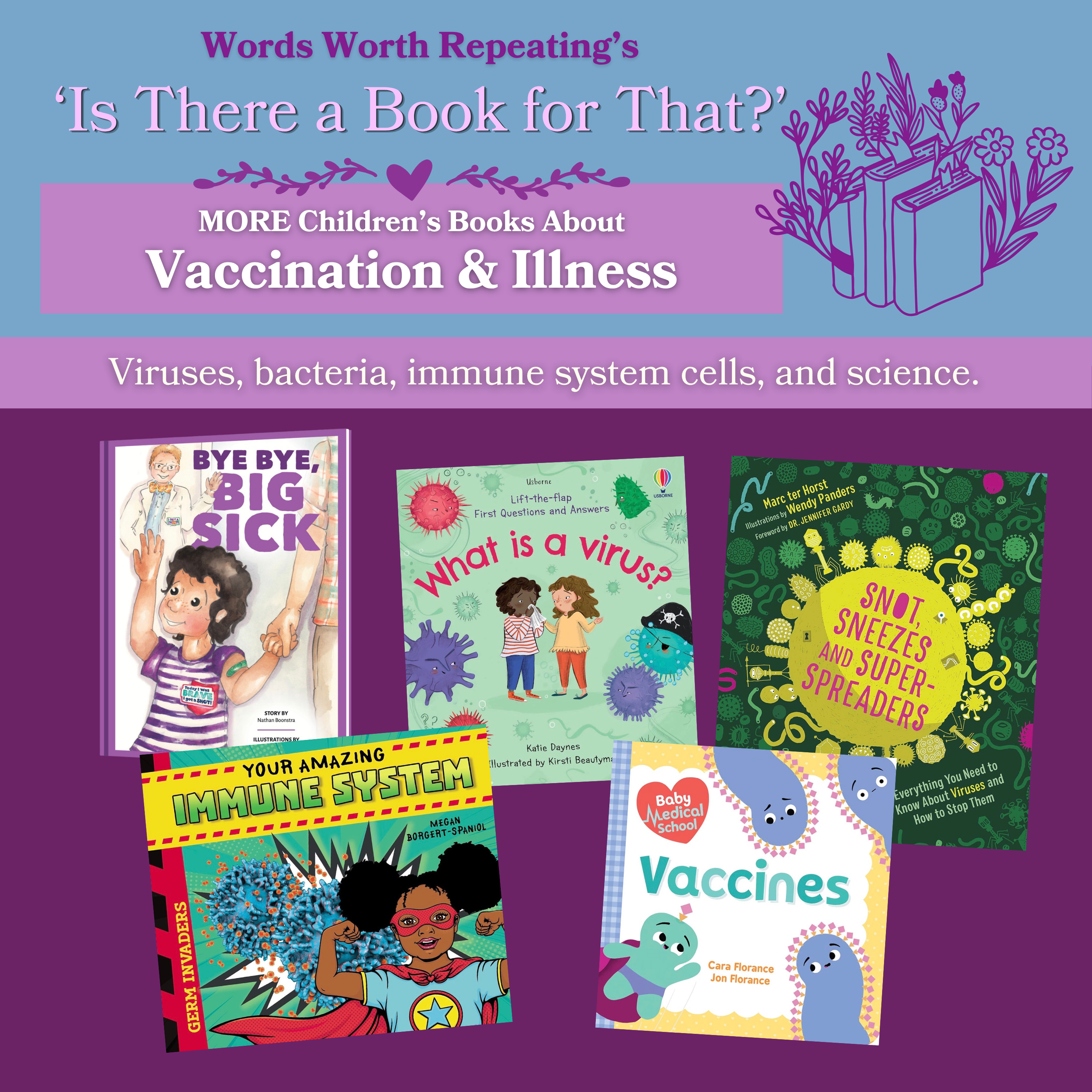
I’ve alreadys shared books about this topic a couple of times before, but I am going to add some more for a few different reasons.
1) Vaccines (via shot) are one of the things kids are most worried about when they go to the doctor. Helping them cope with and find ways to get through a shot is helping them become adults who take care of their bodies even when it isn’t the most fun thing to do.
2)It can be hard for kids to understand why vaccinations are important, and it can be hard to explain why a poke today is better than an illness months from now. Having conversations weeks before hand to build an understanding and having more conversations after to help kids evaluate what they experienced and why are both a part of that process. Books about vaccinations and germs can inspire important conversations. Whether you are a parent or a health care provider having these books on hand to educate and explain can be so helpful.
3)Vaccinations are a part of healthcare based on research and science. There are people out there spreading theories based on bad research and fear. Having these conversations as a family can give caregivers and opportunity to talk about this issue and how your family decides where to get its information.
Today’s books include a book for really little kids, a book for teens (and adults!), and a few in between, but there are several others to choose from. Go to my blog home page and use the search bar to find previous posts! (Searching “vaccines” works great)
What is a virus? - Lift-the-flap First Questions and Answers by Katie Daynes
This book explains many aspects of viruses including what a virus is, the different types, how people catch them, and how people can protect themselves. Like many Usborne books, the book has many flaps that kids can lift to get more information. These can also be helpful if a child has a short attention span and there are certain aspects the adult reader wants to focus on. Uniquely, this book has one spread that lists many different viruses and then how contagious they are and how you can protect yourself. Be warned that the information on COVID-19 is dated, but an adult reader can easily explain the changes that have happened in 5 years. I do think this page is helpful to show the different viruses that would be a concern if not for vaccines. The book does also have a page spread about vaccines, answering many common questions such as how often, does it work for all viruses, do I really need it, and more about antibodies. Under one flap, there is a picture of a child getting a vaccine and the nurse is saying “It will just feel like a small scratch”. Obviously, this isn’t how it feels for everyone. This can be a great opportunity for a child and an adult to talk about what a shot does feel like, why a nurse might try to minimize it, and what the child can do to help it not hurt so much. If you want more support on that, this book might not be the right one for you, but if you are looking to explain the “why” so that kids build coping through understanding, this book would be a great addition to your home library. Also, a great addition to any medical clinic or pediatrician’s office. Even though this is a lift the flap, board book, I think it is most appropriate for elementary school kids, rather than young children.
https://amzn.to/4xdhIm4
Vaccines by Cara Florance
This book simply explains the different aspects of the immune system and how they fight germs. Then it explains vaccines and how they relate. This can help children understand the mechanics of a vaccine. The illustrations are cute and amplify the message. The book is simple and could be read to preschoolers, but some concepts may not sink in until elementary school. This book does not talk about shots or who needs vaccines. It just simply talks about the bodie mechanics helps kids understand how vaccines work- which again can be an important conversation before and after a trip to the doctor. https://amzn.to/3UEOeAg
Bye, Bye Big Sick by Nathan Boonstra
This story is about a girl who turns five and goes to the doctor for her annual checkup. She is worried that there will be shots and doesn’t understand how a shot could keep her healthy. Her doctor explains the shot in simple words as keeping her from getting a “big sick”. They talk about how doctors get shots too and how they feel. The doctor tells her to focus on how quick a shot is and how much they help her body. This book could be an important tool for families looking for child-friendly words to build coping skills based on understanding, preparation of what to expect, and stickers. 🙂 Good for preschoolers and early elementary school. Also available in Spanish. https://iowapha.org/big-sick/
Your Amazing Immune System:Germ Invaders by Megan Borgert-Spaniol
This book teaches the reader about the immune system including how it works, the cells involved, how vaccines help, how people can help their immune systems, and when medical care or medicine might help. This book uses a lot of super hero and “fighting” analogies when it comes to cells and germs. This will resonate with some kids more than others. The book is a little more wordy and would be good for middle to late elementary school-aged kids. A good addition to hospital and medical clinic libraries to add to kids' understanding of their bodies.
https://amzn.to/4cEH318
Snot, Sneezes, and Super-Spreaders: Everything You need to Know About Viruses and How to Stop Them by Marc ter Horst
This book is full of interesting, historical stories about viruses, illnesses, how society has reacted, and the evolution of vaccines. Some are written like a mystery to show the reader how scientists can use medicine like detective work. This book is wordy and tells long, detailed stories. So it would definitely be for middle school-aged kids or older. I think a lot of adults would be interested in it. While it is long and wordy, it does mostly explain things in easy-to-understand words. The stories are engaging and help the reader relate and understand aspects of illness and vaccination in relation to people and geography. There are lot of stories about vaccines and how much difference they have made in the world which could be important for your teenagers who are leary of shots. The book would also be helpful if you have an older kid who asks a lot of questions or who is coping with an illness, this educational book could be a good way to engage them and help them understand more. There are some stories that could be triggering including one about a grandparent dying from COVID-19, Freddie Mercury dying of AIDS, and more.. Please keep that in mind if the teen is high anxiety and/or coping with a significant diagnosis this will not be the right book for them.
https://amzn.to/4A5Edw7
As always, if you purchase books through some of these links, I do make a small commission which helps be able to give my time to previewing and sharing all of these books with you. I’m also a big fan of finding these books at your local library or local book store!
