
Children’s Books About Specific Cancer Experiences
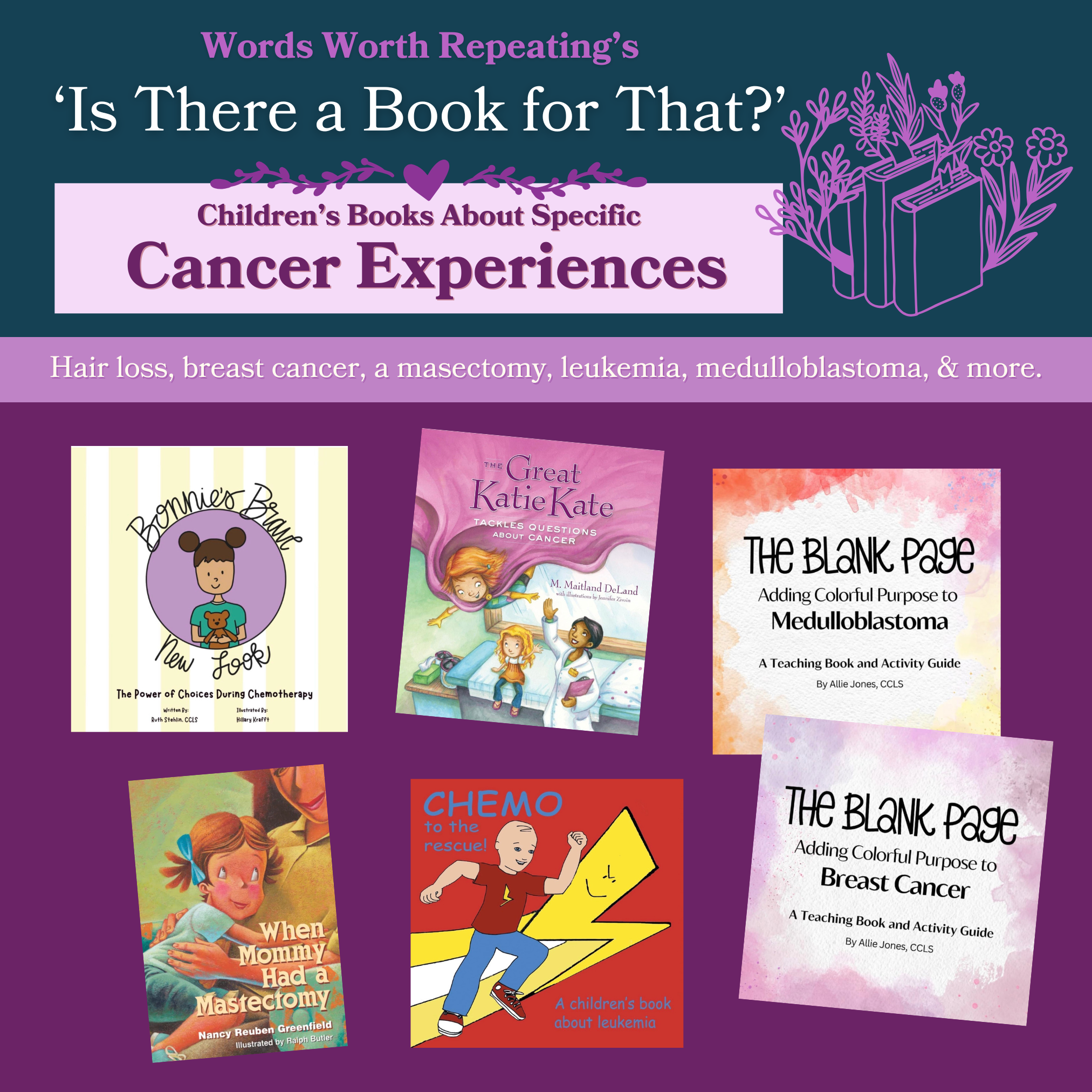
Cancer journies can be long and stressful in a variety of ways. Even after the child starts to develop an understanding of the disease and it’s treatments, the side affects, the procedures, and the time away from every day life can take a toll. So there is room for a variety of children’s books that support different parts of the journey and different kinds of cancer. Thankfully, we live in a time where more and more resources are available.
Today, I am sharing books that support families during cancer treatments. Some focus on a specific kind of cancer, some focus on the feelings that come with it, and some focus on specific treatments and side affects. There can be a focus to find resources to prepare a child for whats to come, and preparation conversations are often an important part of helping a child cope. Yet, books can be a little limiting as they often won’t have the details exactly right. So yes, you can use these books to prepare your child, but I challenge you to also work with your child life team and your medical team to learn more about the specifics in your situation. I do feel that the details are little less important when using these books to start conversations in the midst of treatment. This allows your child to be the expert - to know their own care and how they feel during treatments and be able to relate or to say that they have a different experience. They may help your child talk about or recognize things that they haven’t before. Months or years later, they may help your child process and build a more accurate picture of what they experienced.
Next week, I will be sticking with this topic and sharing more books about cancer, but geared toward older children. So if someone in your family is battling cancer or you work in the hem/onc space, please stay tuned. Also, keep in mind that I have previously shared some other cancer books. Use the blog search bar to find the books that are right for your family. As always, I make a small commission on some of the links. This helps me justify all the hours I spend looking for these books! I hope you find it helpful.
The Blank Page Adding Colorful Purpose to Breast Cancer by Allie Jones
This book was written by a fellow child life specialist. The book uses a page as an analogy for a person, talking about the different emotions and experiences that make up the entire page. When the “page” gets Breast Cancer, the teacher page teaches it more about Breast Cancer using an analogy of cancers cells being like Lego bricks. The book talks about potential treatments like chemo, radiation, and surgery in a way that kids can understand. The book talks about feelings they might have, while instilling hope that things will get better. As a bonus, there are several hands-on activities on the last several pages. (Allie is always coming up with more diagnosis teaching books, you can find them at www.childlifetogo.com). Would be good for preschool through elementary. Also, available in Spanish.
https://amzn.to/4uCvoH4
The Blank Page Adding Colorful Purpose to Medulloblastoma by Allie Jones
This book is in the same style as the previous book and is a part of the series of books, written by a certified child life specialist, that supports families through many different diagnoses. The book uses a page as an analogy for a person, talking about the different emotions and experiences that make up the entire page. When the “page” gets Medulloblastoma, the teacher page teaches it more. The teacher page explains Medullo blastoma using an analogy of nerve signals from the brain to the body being like trains. When one of these trains becomes a “cancer train” the teacher page explains that it can spread to other trains and that there might be different possible treatments like chemotherapy, radiation, or surgery. The book also touches on different ways people might feel while getting treatment, feelings they might have, and instilling hope that things will get better. As a bonus, there are several hands-on activities on the last several pages. (Allie is always coming up with more diagnosis teaching books, you can find them at www.childlifetogo.com). Would be good for preschool through elementary.
https://amzn.to/4nWR4v6
Chemo to the Rescue: A children’s book about leukemia by Mary Brent
This resource teaches the reader about leukemia. The book uses simple words to explain red cells, white cells, and platelets. With easy-to-understand words, the book explains their jobs and what happens when “lazy” cancer cells are made by the bone marrow instead. The book then talks about chemo and how the boy in the book gets chemo. The book talks about “magic EMLA” and shows the nurse accessing the child’s port. This part could be dated, as there are other numbing creams and other ways that nurses give chemo such as an IV or central line. So please be aware that you may need to clarify how a child’s care is different. The book then continues to talk about several other aspects of getting treatment for leukemia including continuing to get chemo even after a child is cancer-free, hairloss, staying in the hospital, and swallowing chemo pills. This book could be useful to educate peers/siblings or talk to a child after being diagnosed with leukemia. The book is fairly long, so you might break it up for preschoolers. School aged kids could probably handle the entire book in one sitting. Keep in mind- while the facts in this book are written in more global way, the illustrations only depict a caucasian male patient.
https://amzn.to/4nWEc8e
Bonnie’s Brave New Look: The Power of Choices During Chemotherapy by Ruth Stehlin, CCLS
This book was recently released by a certified child life specialist. This book tells the story of a girl with cancer. The book starts by describing the cancer cells and how chemotherapy stops it. The book then talks about how chemo will make her hair fall out. It addresses feelings that might come with that. The girl in the story is given a choice of how she wants to handle her hair coming out. It talks about the many kids she meets in the hospital and the different ways they handle it. From shaving it before it falls out, to lint rolling as they go, to cutting it short, to wearing a hat, and several more. In this way, the book shares the many choices kids can make and gives them a little information about each choice so that they can choose what is right for them. This book should be on the shelf of every hem/onc department, so that kids can be empowered to understand their own needs and make choices that are right for them. This book would be appropriate for any age, but most appropriate for kids losing their hair from chemo.
https://amzn.to/49nAAGf
The Great Katie Kate Tackles Questions About Cancer by M. Maitand Deland
This book tells the story of a girl who has a bump that grows and doesn’t go away. The doctors tell her and her family that it is cancer, and she starts to worry. While the doctor talks to her parents, she talks with “the great Katie Kate”. The great Katie Kate appears to be a child who knows all about cancer and cancer treatment, but they do not dig into who she is and why she knows. The child is also introduced a giant creature who is her “Worry Wombat”. The wombat shrinks as the child feels less and less worried. This book talks about many common procedures and treatments for cancers and what each experience is like, things like staying in the hospital, getting anesthesia, using a port, radiation, chemo, surgery and more. The book does not state that every child will have each of these things. Many of the experiences, like a blood test and a biopsy, feel like “a little pinch” to the great Katie Kate. While kids might not all describe those tests as feeling like a little pinch, the main lesson taught by the great Katie Kate is that kids feel less worried when they ask questions so they understand. I do think this is a very important lesson for families as they take on a new and worrisome diagnosis. So I don’t necessarily suggest this book to prepare kids for their first procedure, but I do think this book is helpful for families in the middle of treatment. It could bring up some important conversations about what questions they still have, how they would explain a procedure to a child who hadn’t done it before, and maybe some things they anticipate coming in the future. Good for school-aged kids.
https://amzn.to/3PMI3rI
My Mommy Had a Mastectomy by Nancy Rueben Greenfield
This book tells the story of a young girl whose mother has breast cancer. The girl loves hugging her mom most of all, especially resting her head on her mother’s chest. Her mom tells her that she has breast cancer and that she will have surgery to remove her breast because it will help her “live longer”. The book describes how poorly her mother feels after her surgery and how the little girls find other ways to play and other ways to hug. The book also discusses the different options women have after a mastectomy in regard to implants, wearing a padded bra, or having a flat chest. This book is written for young children, but it is also very honest. It can be helpful to prepare them for their mom not feeling well, but eventually, getting better. There were a few pages that I thought could have been more gentle, like pointing out how poorly her mom looked after surgery. For some families, it might help to wait until after the surgery and once mom is home and they are working on adapting everyday life, this book might be something the child can relate to without being alarmed. Written for preschoolers through early elementary.
https://amzn.to/4uCf09x
