
Books for Older Kids/Teens About Cancer
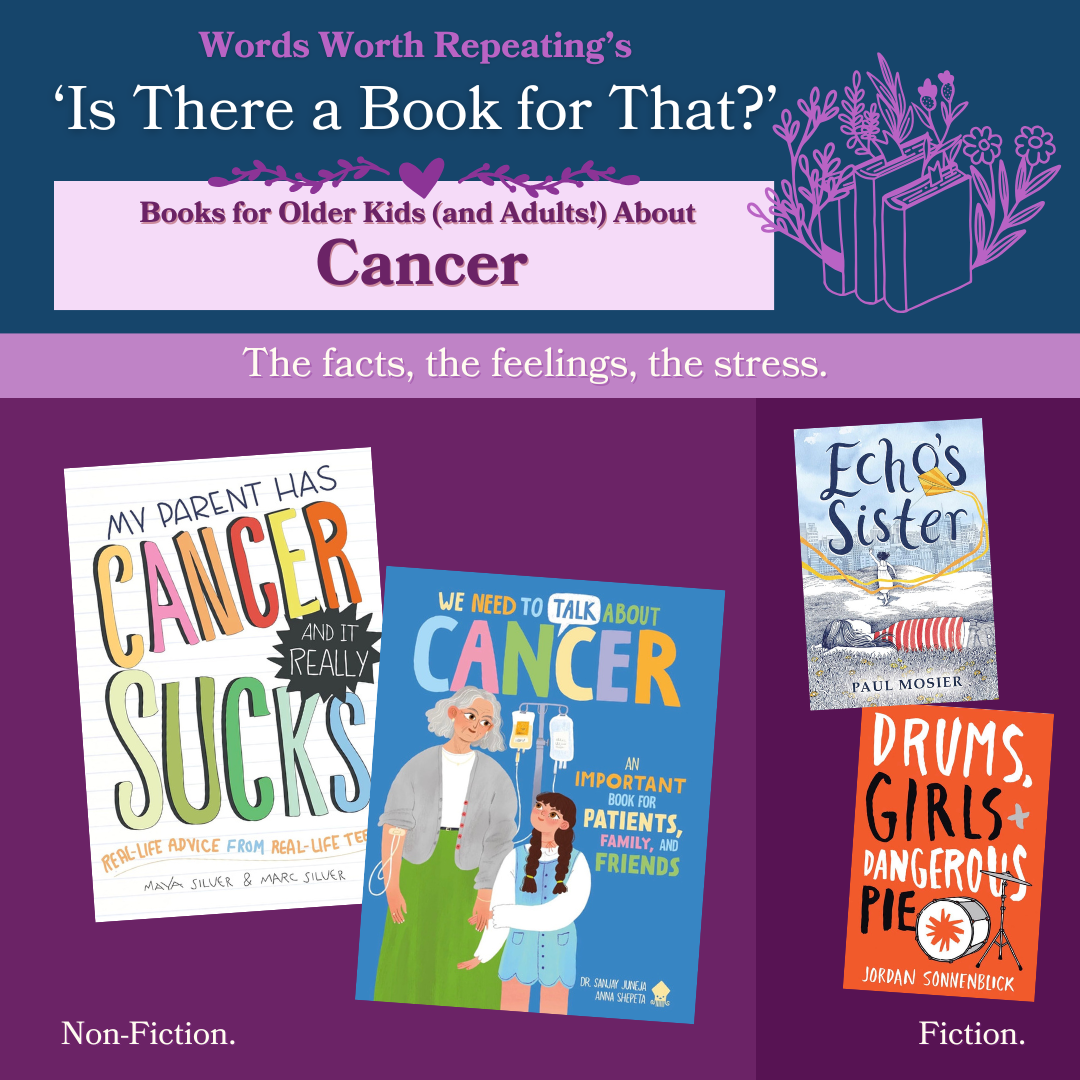
While some weeks I am shocked at home many resources I can find, this week did not go that way. Unfortunately, I couldn’t find a ton of great books about cancer for teens. Luckily, there are a few great ones that I will be sharing today, but before I do, I wanted to talk about a few things.
First of all, I wanted to challenge all of you to think about these books as also being great resources for adults. When we encounter something stressful like a cancer diagnosis, it can be hard to absorb all of the new information. These books that break things down into digestible bits and use relatively simple words can be a great tool to increase your own understanding. In addition, kids need different kinds of support at different times. When a book isn’t the right tool for your child, using one of these books to increase your own understanding can help enhance your conversations.
Second, there might be a reason that there aren’t a lot of great teen books about cancer. A book might not feel like best fit for all stressed teens. As a parent of a teen, I know that the moments of connection can be random and fleeting. They might think a book is lame or not have time for that. I find that just having the resources lying around can allow them to decide when they want to know more. The trick is giving them the information AND following up, to see what their thoughts/questions are. Here’s one idea. Read the book first and fill the book with post-it notes with your own thoughts and questions about the book. Tell them if they want they can add their own post-its with their own thoughts. The post-its can say things like “Ug, this part stresses me out!” or “Wait, I still don’t get it.” or they can say “This makes me want to ask Dr. Smith about Immunology and how I’m going to feel”. This normalizes expressing how they feel, acknowledging that the information is heavy, and gives them a chance to express.
Lastly, I don’t necessarily think that all of these books are good for all teens depending on their situation and their outlook. Specifically, the fiction books seem like they could be triggering as they both include a minor character dying of cancer and the community throwing big events and shaving their heads. Read more below for details. I did include them because I do think they could be very helpful in building perspective for teens that are not directly impacted, but have a peer who is. They might build empathy and encourage more questions and understanding.
Anyway, learn about the important tools I found below. As always, if you know of another great one, please pass the info along as I will always be adding to the list. Feel free to click on the links to learn more about each book. If you happen to purchase one through a link, I do make a small commission at no cost to you (that helps me be able to justify all of the time I spend finding these great books!)
My Parent has Cancer and It Really Sucks by Marc and Maya Silver
This is an important educational and honest book that shares real life experiences from teens who have had parents with cancer (and some experiences from their parents as well). It's honestly my favorite book that I have found for teens so far, and I love that Kathleen McCue, certified child life specialist and the author of a parenting book adds lots of real life stories and advice. It acknowledges a large variety of experiences in a way that promotes honest conversations while also helping teens understand why those conversations are hard for adults. It also acknowledges feelings such as shock, anger, depression, optimism, self-pity, helplessness, denial, and coping strategies to manage these feelings/stressors. It gets into lots of aspects of cancer treatments and is written in a way that can be read in little chunks or full chapters at a time. I appreciate that the book talks about the additional pressure and stress that can be put on teens while also encouraging them to take breaks and be teens, not adults. There are also a couple pages about teens acting out including drugs, alcohol, and getting pregnant or punching holes in the wall. It offers suggestions such as a social worker/psychologist, and it teaches the teen how to patch the wall! This book works hard to be real about the positives and negatives of optimism, faith, prayer, meditation, friends, gender, social media, things people say, and school. I love how honest and non-judgemental it is, but it might be a lot for families who are not used to honest conversations. For those families, it might be better for a child life specialist or therapists to recommend parts or talk them through chapters. There is a chapter on dire prognosis, and another chapter about losing a parent to cancer. It is an important reality for some families that need to be addressed, you can talk with your teen about whether these chapters are right for them.
Lastly, the way the book explains cancer and gives emotional and relational suggestions makes it very appropriate for adults as well, especially adult family members who are also taking care of the adult with cancer. So I recommend this book from middle school through adult.
https://amzn.to/4e2e9Yu
We Need to Talk About Cancer - An Important Book for Patients, Family, and Friends by Dr. Sanjay Juneja
This book was written as a way to explain many aspects of cancer to young people. As I read it, it was very apparent to me that this book was written by a doctor who wanted to make sure that lots of aspects were explained and that the information was appropriate for a wide range of cancer situations. This means that the book contains a bunch of great information, but it also means that the language is not super simple. Therefore, even as a picture book, I find that this book is most appropriate for middle schoolers through adults - yes, adults can benefit from getting information from picture books. It could also be appropriate for elementary school kids who have a lot of questions or a more mature understanding of the topic. This book is unique because it explains many aspects of cancer care that are not in other children’s books including different kinds of cancer, warning signs, cancer stages, how cancer starts, immunotherapy, outpatient care vs. inpatient care, targeted therapy, palliative care, living your life during the “waiting game”, chronic cancer, scanxiety, how to support others with cancer, and cancer research.
A couple of notes on some of these topics: Palliative Care- I love this page. Palliative Care is described as considering how you feel and making choices that are good for you instead of a death focus (yay!). I also appreciated the cancer staging page and how it was careful to explain that all situations are different and how someone doesn’t have to be “cancer-free” for a treatment to have been successful. I did not love the warning sign page. This page shows that some very common experiences like sunburn and being overweight can cause cancer. While I understand the factual truth to this, I do think it could have been worded in a more gentle way, as I do think it could increase a child’s anxiety about more cases of cancer in their family.
Lastily, this book might be most helpful for adults - it is a great tool to increase your own understanding on certain topics so that you have honest conversations with your kids and maybe even choose small sections to read and then elaborate on how it impacts your own situation.
https://amzn.to/3RHhoNH
And now, fictional books about teenage cancer siblings. Please read these descriptions to see if these books are right for your family. They may be most helpful for friends of cancer siblings and may hit too close to home for cancer siblings - depending on the child and their journey.
Echo’s Sister by Paul Mosier
This is a fictional story about a middle school girl whose younger sister is diagnosed with cancer on the same day as she starts a new middle school. The book touches on many common cancer sibling feelings such as worry, witnessing parent stress, financial stress, finding ways to cope as a family, not feeling like themselves, having to sacrifice extras, feelings about shaving her head, and wanting people to like you not feel sorry for you. In the story, she makes a new friend who (spoiler alert) has a sibling who died of cancer. This could be triggering for families. The community pulls together in many ways to support this family including many people shaving their head, donating money, and more. I like the honest portrayal of how that makes her feel, but it also could be hard for families who haven’t found the same amount of support. If there is pediatric cancer in your community, this book can help your children understand some of the things the family is experiencing and feeling. For actual siblings of cancer patients, it can help normalize some feelings, but may also bring emphasis to certain stressful aspects of cancer. So please take into consideration the sibling and the kind of support that would be most helpful.
https://amzn.to/4o8Vw9V
Drums, Girls, and Dangerous Pie by Jordan Sonnenblick
This is another fictional chapter book. This time it is about a middle school boy whose younger brother is diagnosed with cancer. I appreciate its attempt to be a depiction of common thoughts and feelings of a cancer sibling. The main character deals with common experiences like bargaining with God, feeling like homework was pointless when his sibling was hurting, noticing his parents struggles, gaining an understanding of his brother’s medical trauma, being his brother’s only playmate, witnessing his parent’s financial stress, wondering about how this all would impact him, and missing big moments because his brother’s care was more important.
There were a couple things about this book that should be noted, as the author builds the story and his relationships, there is a focus on his attraction to a girl in school. His comments about her body aren’t inappropriate, but they might make some readers uncomfortable. Also, some of the depictions of the younger brother’s medical experiences might be disturbing to some, using words like “jab”, “giant needle”, etc. This is how the character sees it… but is not necessarily an accurate representation. Lastly, there are a few dated aspects, pay phones are referenced and medically, most kids are now sedated for bone marrow aspirations (the younger brother is not in this book) and use other pain management that isn’t a part of this child’s care.
Lastily, there are a couple of things that happen within the book that I think warrant conversations between the reader and a parent and may even make this book not good for a cancer sibling (depending on the child and the situation). The book ends with the teen choosing to miss his big performance because his brother spikes a fever. The teen also meets another cancer patient in the hospital who later dies. The book links these two events and makes a final point about how sad it was that she died without a sister beside her and how important it has been for him to be with his brother. I worry about putting the weight of that on a teen sibling. I would suggest that a parent talk to siblings about the importance of being present in their own life. This book can encourage families to talk about how they make decisions together, while attempting to take the pressure off a teen to be constantly present. Ask your reader how they felt about that part and share your own feelings - acknowledging that every child in the family has needs.
Despite all of these things, I appreciate how this book brings attention to a sibling’s experience and all of the hard things that are related. I think most middle school/high school cancer siblings can relate. I could see it being helpful for friends of a cancer sibling, as it might give them perspective to some of the things their friend is feeling.
https://amzn.to/4397d71
Also, become a Kindle Unlimited member and read this (and a lot of the books I suggest for free): https://amzn.to/4a6cWhG (Kindle is Unlimited for the first 3 months!)
