
Children’s Books About Rare Disease (Cont.)
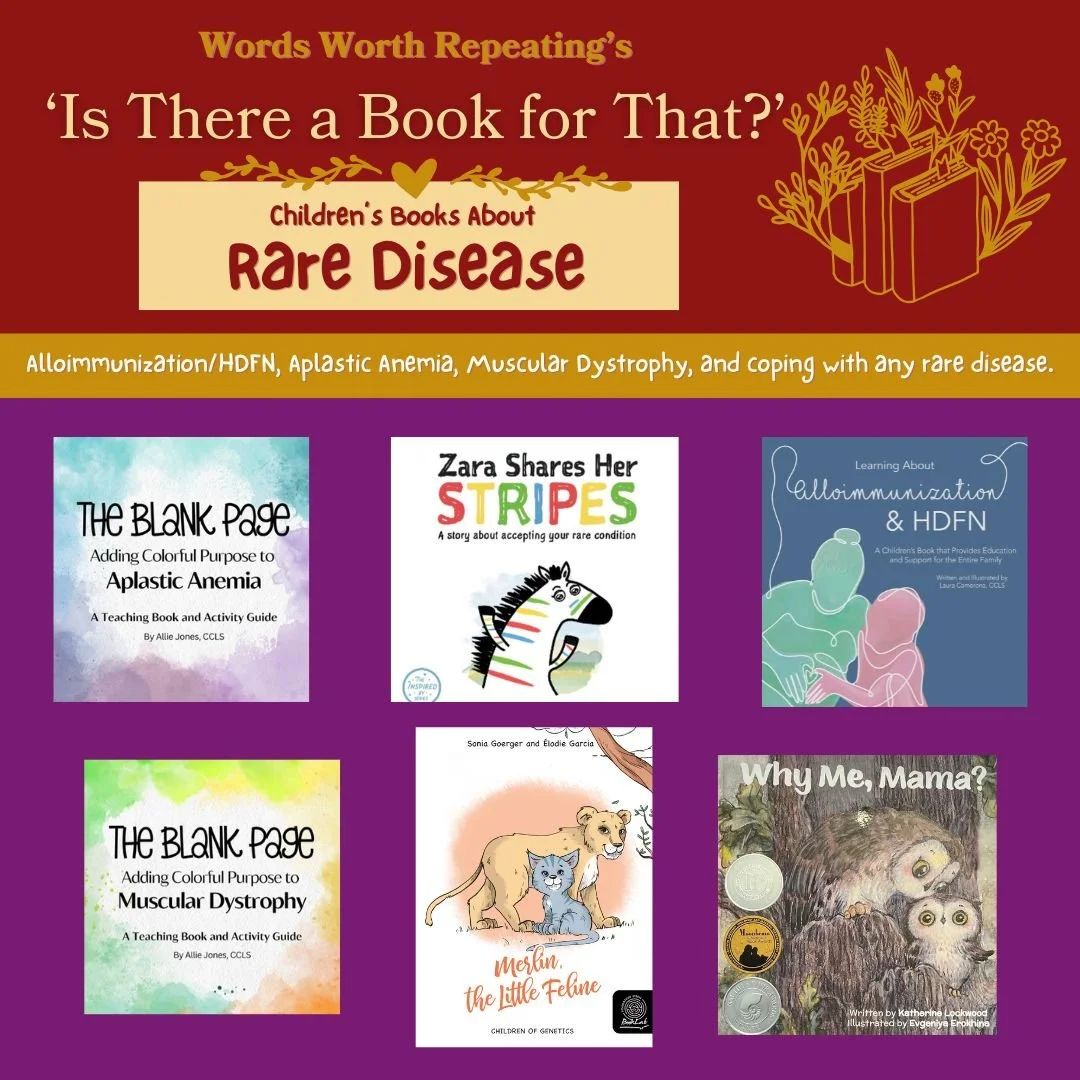
With Rare Disease Day coming at the end of the week, I am excited to share some more children’s books about rare disease. I was fortunate enough to find some more great titles that support children with any rare disease AND some titles that support specific diseases. Both kinds of resources can be an important part of having family conversations about self image, confidence, what to expect, and how to deal with people. As always, you can read below to learn more about each title and find the ones that are the best fit. You will find a link with each title that helps you find where you can purchase or where you can download for free! I do receive a commission on a few of the applicable links, but no extra costs on your end (or on the author’s end!).
I have shared rare disease books previously as well as some books about diversity and inclusion. If you want to learn about more titles than the ones listed below, I highly recommend using my new blog search bar and typing in ‘rare’. It will suggest a couple of my previous blogs with more rare disease children’s books.
The Blank Page: Adding Colorful Purpose to Aplastic Anemia by Allie Jones
Written by a child life specialist, this book uses a page as an analogy for a person, talking about the different emotions and experiences that make up the entire page. When the “page” gets Aplastic Anemia, the teacher page teaches it more about Aplastic Anemia. The book explains Aplastic Anemia by explaining bone marrow as being like a garden that grows cells for the body. The book explains the symptoms Aplastic Anemia patients might have by relating them to the cell’s jobs, and then explaining hospital care (transfusions and stem-cell transplants) that can help the symptoms and the body. The book talks about feelings they might have, while instilling hope that things will get better. As a bonus, there are several hands-on activities on the last several pages. (Allie is always coming up with more diagnosis teaching books, you can find them at www.childlifetogo.com). Would be good for preschool through elementary. The book has so much content that it would most likely be better processed as parts. An adult could use parts of it to talk to classrooms, siblings, or patients. Also available in Spanish.
The Blank Page: Adding Colorful Purpose to Muscular Dystrophy by Allie Jones
Another resource by the child life specialist at Child Life To Go. The book uses a page as an analogy for a person, talking about the different emotions and experiences that make up the entire page. When the “page” gets muscular dystrophy, the teacher page teaches it more about muscular dystrophy. The book explains muscular dystrophy in a way using several analogies. An adult caregiver can help clarify some of these explanations. It starts with analogies that explain why a person has muscular dystrophy, followed by how it affects the body, and then potential treatments. The book talks about feelings they might have, while instilling hope that things will get better. As a bonus, there are several hands-on activities on the last several pages. (Allie is always coming up with more diagnosis teaching books, you can find them at www.childlifetogo.com). Would be good elementary aged kids. The book has so much content that it would most likely be better processed as parts. An adult could use parts of it to talk to classrooms, siblings, or patients. Also available in Spanish.
Learning About Alloimmunization and HDFN by Laura Camerona
This book educates readers about how alloimmunization works in the body in simple words. The book also explains multiple experiences and procedures that can happen as a result. The book also explains how HDFN happens and different HDFN/NICU experiences that relate to alloimmunization. This book was written in a manner that supports families no matter their alloimmunization experience and can be used with children whose mother’s pregnancy involves alloimmunization. I can also be used for family members who are trying to understand on a simple level or for children who had HDFN to read later in their lives. This book was commissioned by the Maternal Alloimmunization Foundation. They contributed to the content, and benefit from each sale. It is appropriate for preschool through adults. Families can choose whether to read just the base text, to read some of the additional text that applies to them, or to read about all of the details and possible experiences.
https://amzn.to/4l7LNPN
Why Me, Mama? by Katherin Lockwood
This book tells the story of a young owl having a birthday party. She tells her mom that she worries about being around all of the other young animals because she is different. Her mother tells her that there are lots of differences, and she is not alone. She then delivers invitations to many different animals. It is remarkable how many different medical/anatomical differences are included in this book, but this part of the story did lose me a bit because it was so long. So if you are looking for representation for your child, please look into the many syndromes and handicaps included. If you are looking for a relatable inclusion story, this one is fine, but for me, it gets a little lost in all of the different characters. Good for kids in young- middle elementary.
https://amzn.to/4s9w19p
Zara Shares Her Stripes from the Inspired By series.
This book is about a zebra with rainbow stripes. Her stripes make her different, so she paints over them to blend in. Then she visits the animal park where she learns that everyone has something that makes them different. She learns that these aren’t things to hide, but can be things to celebrate or to educate other about. This book also continues a few random facts about rare disease (although personally those felt like they were more for adults than really adding to the story). This story would be great for young children through early elementary. It appears that this book has been created by a pharmaceutical company who will send you a free copy in exchange for your info.
There are other books in their inspired by series that I hope to share in the future. All available here: https://alexioninspiredbybooks.com/ Also available in Spanish.
Merlin, the Little Feline by Sonia Goerger
This is the story of a lion cub who doesn’t look like his peers. The lion cub and his mother seek answers. They are told to travel and talk to others and see if they find anyone else who is the same. Some groups of animals are rude. Some groups of animals are kind. Finally, they find another cub who is similar. The lion cub feels good about being special and finding someone else who can relate. This book is good for young children through elementary. It might be a good tool for schools to use with classrooms who have a child coping with a rare disease.
https://amzn.to/4r098nV
Also downloadable here: https://www.fondation-ipsen.org/book-lab/merlin-the-little-feline/
If you’ve searched the blog and can’t find a book about a specific topic, reach out through email or social media to let me know. I’d be happy to do some research and try to feature that topic in the future. Thanks for reading.
