
Children’s Books About Brains
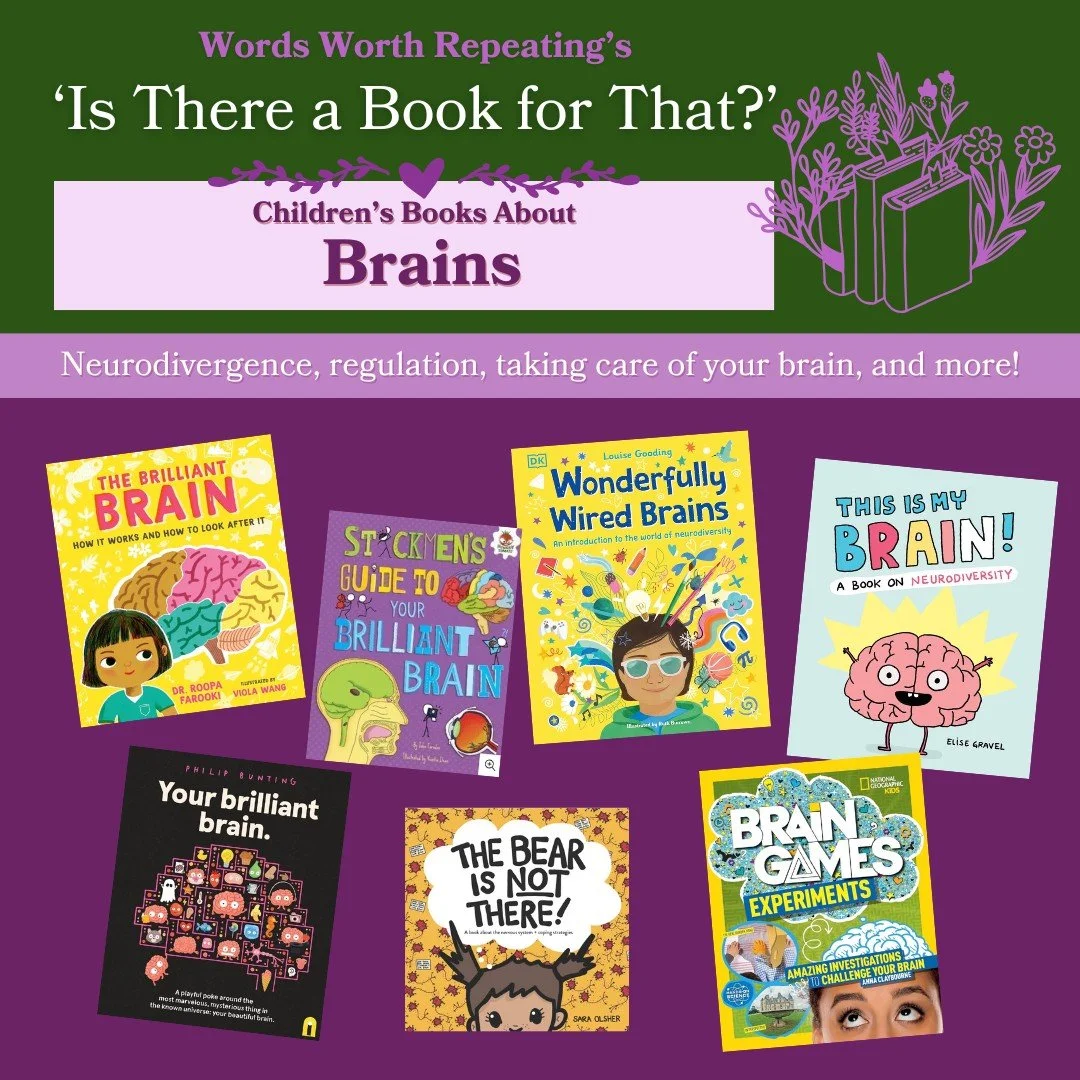
The amount of children’s literature available on the brain and neurodivergence is growing- and thank goodness for that! As I work on my own book about mental health, it was fun to explore more of the books already available for families. There is a lot of overlapping information within these books. So I don’t necessarily recommend reading all of these books to the children in your life, but rather find the one or two that are the best fit for where they are. This week I am listing the books below in order… starting with the most simple and ending with the most complex. I am hopeful this will help families figure out what book is right for their kids. If you are neurology nurse or a hospital librarian, just buy them all. They will all help families in their journey to understanding brains, their reactions, and their health.
I do want to highlight my a few that stand out as being different than the rest. The Bear is Not There! is a unique book in talking to kids about regulation and how their brain reacts. Wonderfully Wired Brains talks about so many different diagnoses and common neurodivergence -it could be just the resource you are looking for. Lastly, Brain Games promotes hands-on learning which is so important when engaging and truly educating kids.
Also, please use the blog search bar to look for other books about other brain related topics. I have featured books on epilepsy, cerebral palsy, and more in the past. The search bar will help you find exactly what you are looking for!
Anyway, read about the books below and definitely click on the links - I was shocked how many of these books are on sale for such a reasonable price! (I do get a small commission for purchases from links that helps me justify the time I spend on this project… although I’ve yet to make much. :) )
This Is My Brain!: A Book on Neurodiversity by Elsie Gravel
This simply-worded book helps kids understand the brain, including its many jobs, how it can be different in different people, and what you can do to take care of it. The illustrations are playful, engaging, and a bit silly. The text is simple and relatable. It does not get into the science or the parts of the brain, but rather keeps things really general. I recommend it for all preschoolers through middle elementary. The book can help you have conversations about differences within your own family, struggles one person might be having, or relating to friends/peers. The book also encourages talking to someone when their brain is having struggles or challenges including a parent, teacher, or therapist.
https://amzn.to/4tyDHSV
The Bear is Not There! A Book About the Nervous System By Sara Olsher
This book teaches the reader about neurons and the nervous system. After an easy-to-understand explanation of how neurons work, the book gives the reader an example of a scenario when a child sees a teddy bear, but the brain sends messages that the bear is real. The book then talks about how the nervous system can make mistakes and ways to reset and evaluate before responding. The book offers a variety of grounding exercises, explaining that different things can work in different scenarios. This book is a great way to start a conversation about how to be less reactive, how to calm, or how to understand big reactions. I recommend for preschool through middle school aged children. This book could also be appropriate for the classroom or for hospitalized children who panic or who are struggling to find coping strategies.
https://amzn.to/4dk0xHD
The Brilliant Brain: How It Works and How to Look After It by Dr. Roopa Farooki
This book teaches the reader about the brain with simple terms and explanations. The book briefly talks about the different parts of the brain and their roles, the thoughts and memories your brain holds, the role of nerves, the feelings the limbic system creates, and how each of these things makes each person unique. This book keeps things pretty basic and engages the readers with colorful engaging illustrations. While still simple, this book goes a little further into the science and different aspects of how the brain works. Good for your early scientific thinkers. Good for preschool to middle elementary.
https://amzn.to/42yeDQV
Wonderfully Wired Brains: An Introduction to the World of Neurodiversity By Louise Gooding
This book focuses on the differences that can exist between different brains. It starts by labeling several different aspects and then building a framework including the different parts, neurons, and its relationship to the brain. This helps kids have an understanding before going into the next part of the book that gives a couple of pages to a wide variety of neurodivergences. For each neurodivergence, the book talks about ways it can present, different adaptations that can help, and scientific facts about the neurodivergence. The book covers topics like autism, ADHD, dyspraxia, dyslexia, synesthesia, dyscalculia, dysgraphia, language processing disorder, several sleep disorders, anxiety, depression, OCD, bipolar disorder, tics, seizures and epilepsy, and cerebral palsy. Next the book digs into the history of our understanding of the brain and a number of famous people who are neurodivergent. This can be super helpful when having honest conversations about neurodivergence and how it presents in the people around them. I can also be used to talk about acceptance and the changing world of science. It is important for kids to understand we don’t know everything about the brain and that there is hope for new information that helps us understand more. This is a great book for middle elementary through middle school, but is best read in chunks. There is a lot of information in this book.
https://amzn.to/4dh7bhR
Your brilliant brain. By Philip Bunting
This book does not keep things simple at all. Instead, this book digs into all sorts of brain facts. The book injects little bits of humor throughout which helps kids engage. Still, this might be a book that an older child reads in chunks, as it is a lot to digest in one sitting. If your child is asking you tricky questions about the brain and you are having a hard time explaining, this book might have your answer. This book also includes a couple of pages about ways to take care of your brain which could be a good way to start a conversation about brain health and how a child can play a role. A good book for middle elementary through middle school.
https://amzn.to/3RkvX9w
Stickmen’s Guide to Your Brilliant Brain by John Fardon
This book is another of the more in-depth books about the brain, better for upper elementary and middle school kids. I wanted to make sure to include it because it is the most medical book that I am sharing today. This book uses some simple medical drawings to help kids understand how brain changes can affect their senses and the way messages travel. If you have a child who has experienced some sort of brain-related diagnosis or knows someone who has, this book might be the best at helping them understand it. It does dive into a lot of different aspects, but it is written in excerpts so the reader could pick and choose what aspects to focus on.
https://amzn.to/4u9iqjV
Brain Games Experiments: Amazing Investigations to Challenge Your Brain by Anna Claybourne - National Geographic Kids
As you might guess, this book is full of experiments that kids can do on their own brains and the brains of their friends/family. This makes the learning hands-on and helps certain concepts make more sense. These experiments focus on a range of concepts including senses, the brain-body connection, thinking, and reactions. If you work with kids in the hospital or school, these are great, screen-free activities that make kids think and build their self-image. If a child is struggling with change, this book could be an important tool to build a more complete understanding of their brains (and how their brains work, make mistakes, and adapt). This book also coordinates with a TV show that my 11 year old is obsessed with… so if you are having trouble getting your older kids to engage, try the show and then follow up by offering the book and some hand-on play. Another bonus, most of these experiments don’t require many supplies. So they also serve as boredom-busters and ways kids can interact with hospital staff.
https://amzn.to/4wo39gm
