
Children’s Books About Skin Differences
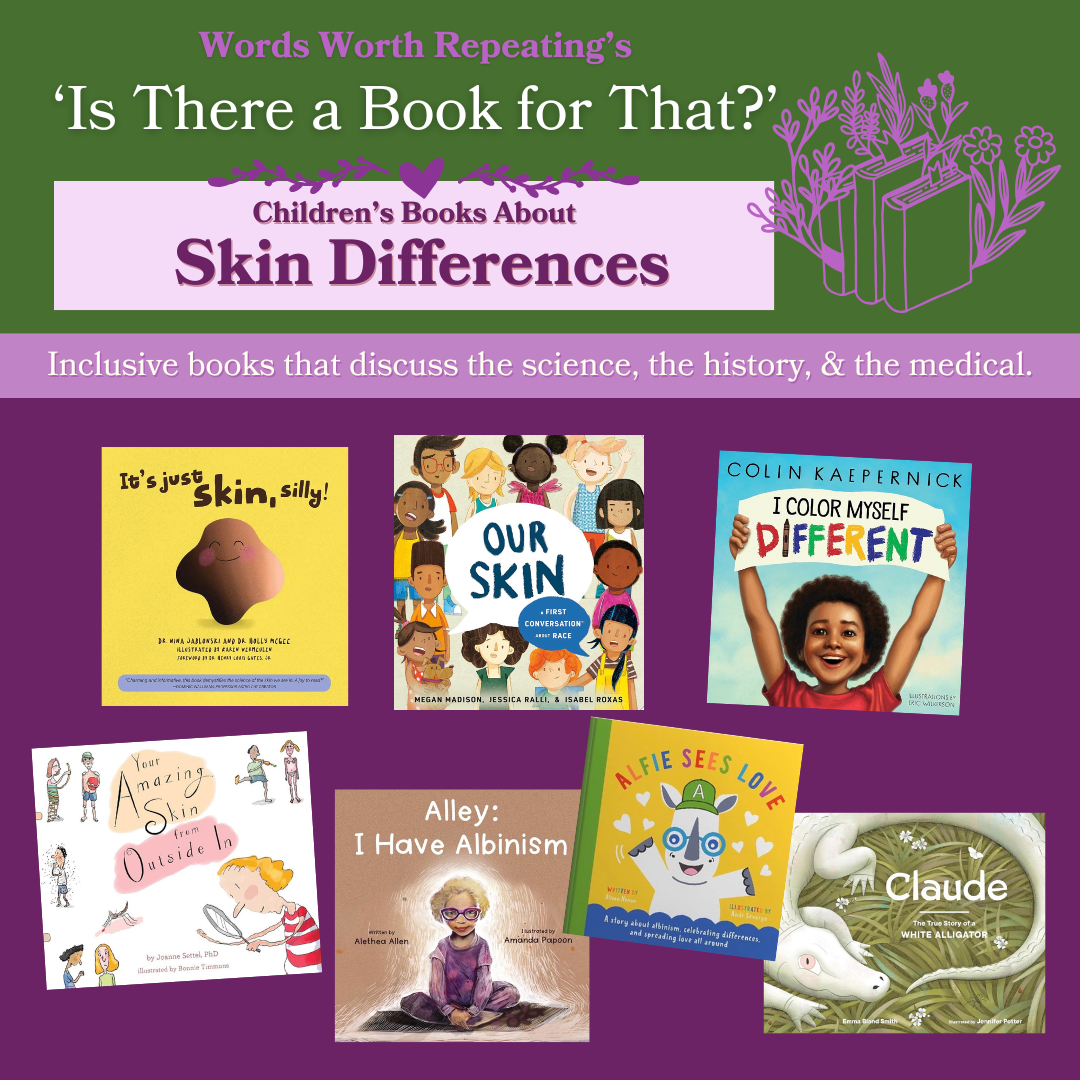
I’m once again excited about what I have to share with you. There are a wide variety of skin differences AND a wide variety of angles that you can talk about them from. I am happy to report that I was able to find books that talk about many of these angles… from a historical perspective to a cultural perspective to a medical diagnosis /experience. Your hospital library probably needs all of these. Your own home might only need a few… but read below to learn more about each book and how it can support your conversations with your kids.
Please note. These conversations are important. I can understand that as adults we might be concerned that a child’s comment about skin color could come across as racist or ignorant. I encourage you to follow your child’s comment up with a thoughtful conversation - these books can help you! Hushing a child and telling them that they shouldn’t talk about it can encourage discrimination. Help them see that their questions are important and that their observations might affect the people they hear them. Both can be true, and kindness and acceptance starts here.
Like always, I receive a small commission from some of these links. This has no affect on what I choose and only helps me be able to give more time to this important project.
Our Skin: A First Conversation About Race by Megan Madison and Jessica Rally
A great first book to talk to your children when they start to notice differences in skin color. This book explains race and skin color in simple and easy-to-understand words. It talks about melanin and about the different words used to describe or title different skin colors in an inclusive and open way. It then talks about racism and the many ways kids might encounter it including in play and in rules made. This book is appropriate for classroom and family conversations about differences and would be great for young children as they start to notice differences and for older children as they navigate tricky situations. Good for young children through middle elementary (available in board book). Also available in Spanish.
https://amzn.to/4um5sim
It’s Just Skin, Silly! By Dr. Nina Jablonski and Dr. Holly Y. McGee
This book focuses on how skin has evolved over millions of years. The book teaches the reader about ancestors having more hair on their skin and how all humans at one time lived in Africa and had darker skin colors. The book talks about the role of melanin, and then from this framework, readers learn about why our bodies evolved based on need and temperature. The book also talks about the emphasis that some people put on skin color and the outdated concept of “race”. If your family is looking for a way to talk about skin color with your children, this book can give them a historical perspective that reframes many of the skin concepts the world focuses on. This book is great for middle elementary through middle school understanding.
https://amzn.to/42STctK
I Color Myself Different by Colin Kaepernick
This book tells the story of a little boy who is excited to draw a picture of his family for a school project. When he colors, he is the only person in his family with brown skin. His classmates have questions about this. His mom explains that he is adopted and that makes him special. The book states that being brown is magnificent and one page shows many brown people who have done important things. The class remembers other brown people in the world and being brown is accepted and celebrated. This book would be especially important for children who are adopted and are a different race than their adopted families, but it is also appropriate for all children. It is a great way to start a conversation about race, acceptance, and diversity. Great for preschool through middle elementary.
https://amzn.to/4enxKUW
Your Amazing Skin from Outside In by Joanne Settle, PhD
There is a lot packed into this book. As an adult, I could not take all the information in at one sitting. On top of that, while written at an upper elementary to middle school reading level, the entire book is written in rhyme. This makes it fun to read, but for me, it also makes it hard to understand. I think this book could best be used a couple pages at a time. There is a glossary that helps you find topics such as sunburn, mosquito bites, bruises, cuts, melanin, layers of skin, temperature change, freckles, fingerprints, sweat, scabs, pimples, warts, and more. If you have curious kids or are looking for ways to educate your child about their body/skin, this could be a good fit - but for many it will need to be broken down into parts. Good for upper elementary through middle school.
https://amzn.to/3QHibOb
Alley: I Have Albinism by Alethea Allen
This book tells the story of Alley, a third grader with albinism, from her perspective. It talks about how she looks and how her family looks. She sees that they look like her even though their skin and hair color are different. It talks about all of the things that make her special like loving to dance and draw and being a big sister, but also her skin color and eyesight differences. The book talks about skin pigment and eyeglass adaptations that she uses. The book also talks about how she feels when people say mean things and how her mom supports her to feel however she feels, but also to know that those things aren’t true. I think all school age kids could relate to this book, and I recommend a classroom bookshelf. I definitely think its an important read for every child with albinism, as it reflects on common feelings and experiences in an honest,yet positive way. This book can be an important tool for the children in your life to better understand albinism.
https://amzn.to/4ncTUeP
Alfie Sees Love by Alison Nenon
This book is a sweet story of an ‘albino rhino’. The book is engaging as the rhino goes on several different adventures. There is an underlying message of inclusivity and diversity. The book does explain to the reader that the rhino has albinism. Its description of albinism will need further support as the book focuses on a fun rhyming pattern, and so it introduces the topic without a full explanation. (It uses the term ‘rare genetic condition’ which readers can glaze over or talk more about what that means). The book also talks about the rhino having poor eyesight and needing help from glasses, a common experience in albinism. The book is cute for all young readers and is a good first book about albinism - introducing the concept and an accepting culture. It looks like this author is creating more titles about Alife, but I was only able to review this first introductory title.
https://amzn.to/3OMEXnf
Claude: The True Story of a White Alligator by Emma Bland Smith and Jennifer M. Potter
This book tells the story of an alligator who is born with albinism in Florida. The book discusses how this makes him more at risk because he does not have natural camouflage and has poor eye sight. The humans take care of him, but he is lonely in a habitat by himself. Eventually, they send him to a different zoo where he can be with another alligator. Unfortunately, he and the other alligator do not get along, and ultimately, the other alligator gets taken out of his habitat. He does befriend the snapping turtles in his habitat and has a good life where he is taken care of and adored by many humans. This story could be a good introduction to talking about how we are all born different and we each need different kinds of care. It could also be used to talk about feelings and being isolated. Children who are affected by albinism might have big feelings about how Claude is isolated or might struggle with the list of reasons that albinism made life harder for the alligator, as people do not have all of the same struggles (ex. Humans do not have the need for camouflage). This book could be normalizing for children who look different than their peers, but since it is a true story of how an alligator was cared for, please be prepared to talk about all of the differences that exist in human care and interactions. Good for young-middle elementary aged kids.
https://amzn.to/4etVsPu
