
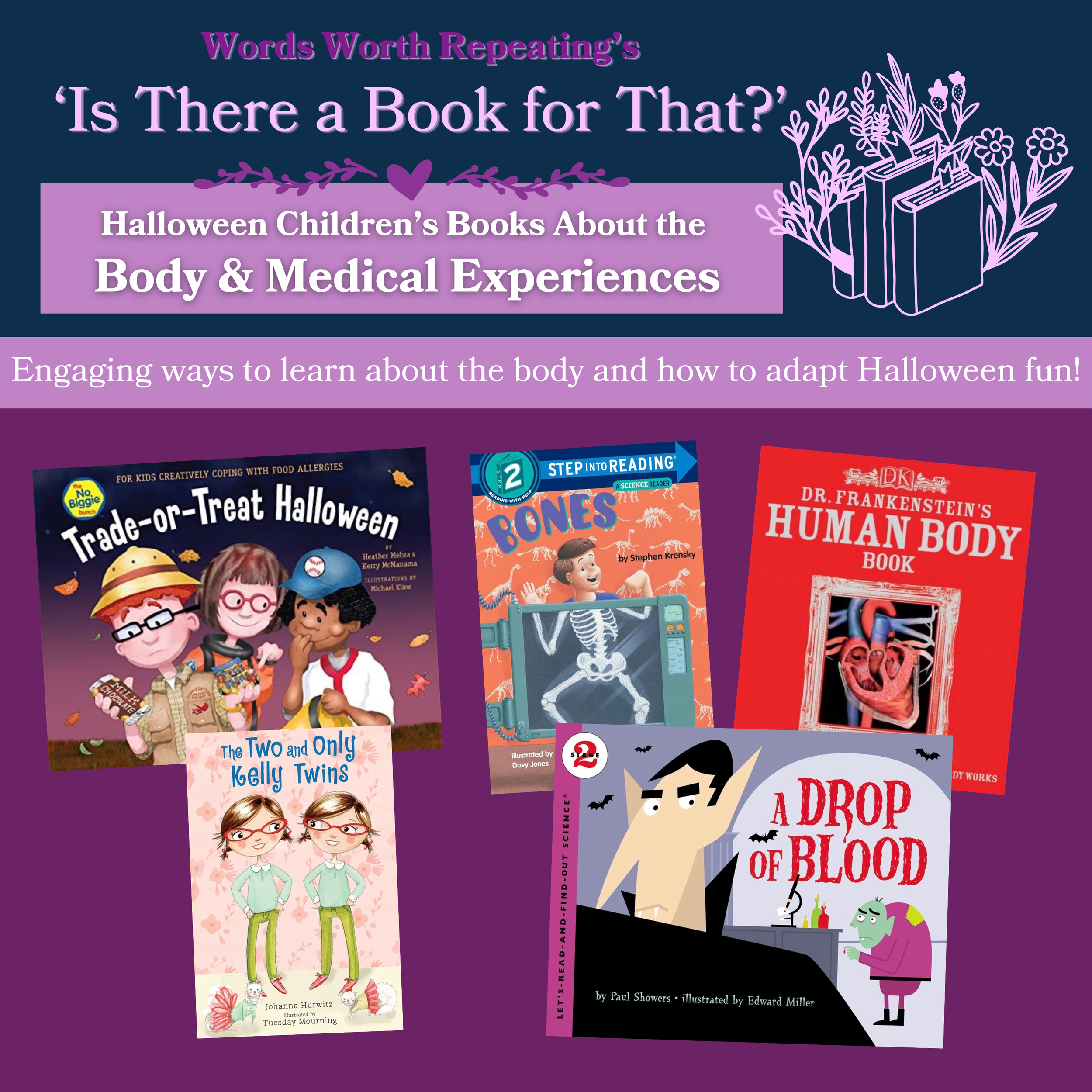
One great way to engage kids is to utilize the next big holiday. Halloween actually lends itself to a lot of medical conversations with all of the blood, skeletons, etc. So take advantage! Kids are more likely to remember and learn when you have their attention and they are having fun. These books can also help you support kids who are freaked out by the blood or skeletons on display around Halloween time. Seperately, I did find one book that supports kids whose diets are limited by an illness or disability. I hope that this book can help them feel less alone and help their families find a way to still make trick-or-treat fun.
Please keep in mind that I did a similar post last year with some more great Halloween themed books. You can find them here:
https://www.wordsworthrepeating.com/stories/childrens-books-about-the-gross-and-the-spooky-halloween-update?rq=halloween
Several of the books from both blog updates would be great for a hospital library or maybe to have in the playroom around Halloween time. Several would also be great additions to clinic waiting rooms or home libraries. Encouraging kids to learn about their bodies will help with future conversations about taking care of your body, being safe, and healthy choices. So check them out!
The No Biggie Bunch Trade-or-Treat Halloween by Heather Mehra and Kerry McNamara
This book tells the story of a group of kids with various food allergies that go trick-or-treating together. One of the trick or treaters is excited when she gets candy that she knows she can’t eat. She explains to her friends that she can trade it for something even better, for her that is glow-in-the-dark star stickers for her room. Her other friends talk about what they would like to trade the candy they can’t eat for. At the end of the book, the book asks the reader to choose what type of trade they would like. If you have a child who can’t have some Halloween treats, this book could be helpful to introduce the idea of trading it for something else. Obviously, this book would be helpful for kids with food allergies, but also kids with gluten related diseases like celiac or kids who are tube fed or NPO during Halloween. This book would be best for young children through early elementary school.
https://link.amazon/B0hBzxsZy
Dr. Frankenstein’s Human Body Book by Richard Walker
What a great find. I recommend this book for every hospital library, middle school library or doctor’s office. The book is written with the concept of Dr. Frankenstein building an entire human. Each page spread talks about different aspects of the body like cells, bones, organs, etc. It also talks about scans and methods of learning about the body. Each spread also includes little notes from Dr. Frankenstein and a general description of the process. The book explains many body functions and parts while playfully engaging. It could motivate a child who is developmentally 10 through adult to learn more about their own body. This book is close to 100 pages, so it will take some time to get through and is better read a chunk at a time. Lastly, I want to point out that it talks about a lot of systems and organs that aren’t included in other books such as lymph nodes, nerves, complex heart function, ears, kidneys, urinary system, tongue, throat, pancreas, trachea, and various muscle systems. https://link.amazon/B0eq9Dqn1
The Two and Only Kelly Twins by Johanna Hurwitz
This is an easy ready chapter book great for kids in middle and upper elementary to read on their own. The book has several engaging aspects including the main characters being identical twins, owning ferrets, and trick or treating with friends. Towards the end of the book, one of the sisters goes to the hospital with appendicitis. The other twin feels weird going to school and other places on her own. When they are back together they acknowledge their sibling bond, but that it is also good for them to have their own individual experience. Reading this book to your young elementary aged kids or talking with older kids after they read it could be a great opportunity to discuss hospitalization, being a hospital sibling, and sibling relationships in general. Kids will resonate with the story, and it may open the door for you to talk about more.
https://link.amazon/B0cgKA3Fu
Bones by Steven Krensky
This is an easy reading book that teaches the reader about bones and the skeleton. The book explains various aspects of bones in a simple, easy-to-understand way. The book does address that some people use skulls to be scary during Halloween and on a pirate’s flag, but that bones are actually necessary to move and so we aren’t just a blob. This book could be helpful to educate kids who are a little freaked out about skeletons or kids who get an x-ray, have a broken bone or are learning about their bodies and how to take care of them.
https://link.amazon/B0dj5Uked
A Drop of Blood (Let’s-Read-and-Find-Out Science 2) by Paul Showers
This book is full of factual information about blood including about different cells found in blood, scabs/healing, the role of the blood vessels and the heart and the amount of blood in a person. The book does use vampires in the illustrations to engage kids. This book could be a fun read (maybe around Halloween) that you can use to combine fantasy and talk of vampires with factual information. If your child is worried about losing blood from an owie, this book would be one way to educate. Good for young school age. Could be used in a classroom to educate kids about their bodies. https://link.amazon/B09o7oDcH
As always, I do make a small commission from purchases using these links. This helps me be able to give lots of time reading books and finding you the good ones. I also fully support finding these books at your local library or bookstore!
