
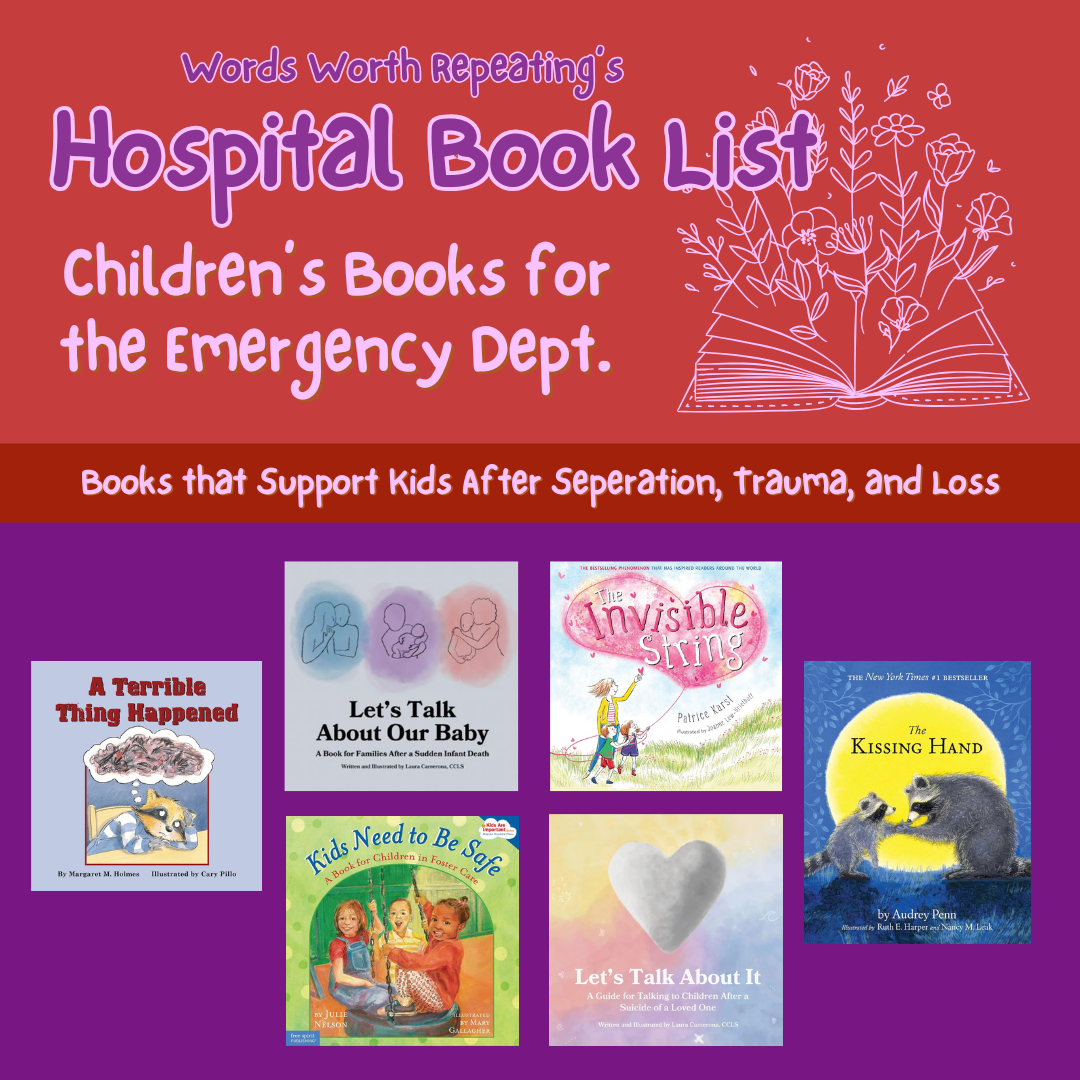
* This image uses the old name of the ‘Is There a Book for That?’ blog/book list.
I worked as a child life specialist in the ER setting during the early part of my hospital career, and I will say - there is truly nothing like working in the ER. Each night would be completely different than the next. One night fevers, rashes, and a broken bone... the next 10 different kids who needed sutures. As a professional, it definitely kept me on my toes, but then there were those nights. The nights that really tragic things happened. Those nights that families needed an entirely different kind of support, and the thing is, no one can control when those things happened. So sometimes, more than one family would be experiencing that kind of trauma on the same night or sometimes it would happen at 3am when no extra support staff was working.
Anyway, my point is: there are amazing social workers, child life specialists, and chaplains in hospitals to support families through hard things, BUT sometimes, they just can't be there at the right moment. Sometimes, families need the tools to work through these hard things. Or even when staff is available, families need the vocabulary to continue to support kids at home. So I compiled some of the books that I find most helpful for these kinds of situations. There are many more books that continue to support grief and hard times for kids, but these are some of my favorite to use in the moment at the hospital. Full disclosure: I did write two of these books as I found there was need for books that applied immediately after a loss.
Read more about all of the books below and if you'd like to learn more about my titles you can find more under the ORDER tab or you can find previews on YouTube.
The Kissing Hand by Audrey Penn
This sweet story is about a young racoon who is worried about being away from his mother while he is at school. His mother reassures him that he will be well taken care of. She kisses his hand and reminds him that he can still feel her close by feeling the warmth of his hand on his face. There are several different reasons that a child might have to be separated from their parent, and this book can be assuring in situations like this. Great for young children through middle elementary.
https://amzn.to/4siGjVe
The Invisible String by Patricia Karst
This book tells the story of two kids who are scared at bedtime. They run downstairs to their mom who explains that even though they can’t see their loved ones, they are never alone. She uses the metaphor of an invisible string that connects everyone that cares about each other, no matter where they are. The book mentions a loved one who has died, and the mother explains that the invisible string connects them to them as well. This is another great book for kids in the hospital who have to be separated from their parents or loved ones. Could also be used in grief and loss situations. Good for preschool through upper elementary. (In the NICU, I used to sometimes make bracelets for the kids and the adults that matched - a clear piece of bracelet elastic with one heart bead on it.)
https://amzn.to/4uCkcul
Let's Talk About Our Baby: A Book for Families after a Sudden Infant Death by Laura Camerona
This book gives families the words to talk about the unexpected death of a baby. This book was written to support families no matter the reason of death. When families in the ER experience the loss of a baby, they often don’t know the specifics of how or why. The autopsy and follow up investigation could take weeks to months and those families need support now. This book was written to be that book. Full disclosure, I wrote this book as a child life specialist after years of supporting families in the hospital. This book and its simple words and inclusive illustrations would be good for all ages of children.
https://amzn.to/4bP6lcF
Let's Talk About It: A Guide for Talking to Children After a Suicide of a Loved One by Laura Camerona
This book gives families the words to talk about suicide. When someone dies by suicide, they are often brough into the ER and families meet there and start asking what they should say to their children at home. Many contemplate keeping the truth from their children, as it seems to heavy and to confusing for kids. The books first pages talks adults through that thinking, explaining why honesty is important and then the remainder of the book helps adults explain. I would say this book would be best for school age kids, but could be used for younger and older kids as their caregiver feels is appropriate. O and again, full disclosure, this book was also written by me in partnership with some amazing child therapists who helped me find the right words and support.
https://amzn.to/4sgPEN7
A Terrible Thing Happened by Margeret M. Holmes
This book talks about how a raccoon feels after something terrible happens. He doesn’t like remembering it, so he doesn’t talk about it. He just pretends that it didn’t happen. This technique doesn’t work. He feels angry and overwhelmed, but he doesn’t understand why. The book talks about how different adults could help and how expressing how he feels helps him feel better. This book might not always be good in the ER after a terrible thing, but it would be good to recommend to families to follow up in the days immediately after. The book could be good for preschool through upper elementary. This book does a good job of keeping things general to be appropriate for many different “terrible things”.
https://amzn.to/47Cduuq
Kids Need to Be Safe by Julie Nelson
This book emphasizes the idea that kids need to be safe and so sometimes kids hae to live with someone beside their parent to keep them safe. It doesn’t go into a lot of details, but mentions a few things that parents need to work on, in order for their children to be safe. Always check with the social worker or case worker before using a book like this with a child going to foster care, as there are sometimes rules about what can and can’t be said. This book could be a nice tool for a staff person to use to explain foster without going into too much detail of their own personal experience. Good for young children through early elementary.
https://amzn.to/3NG2eXc
