
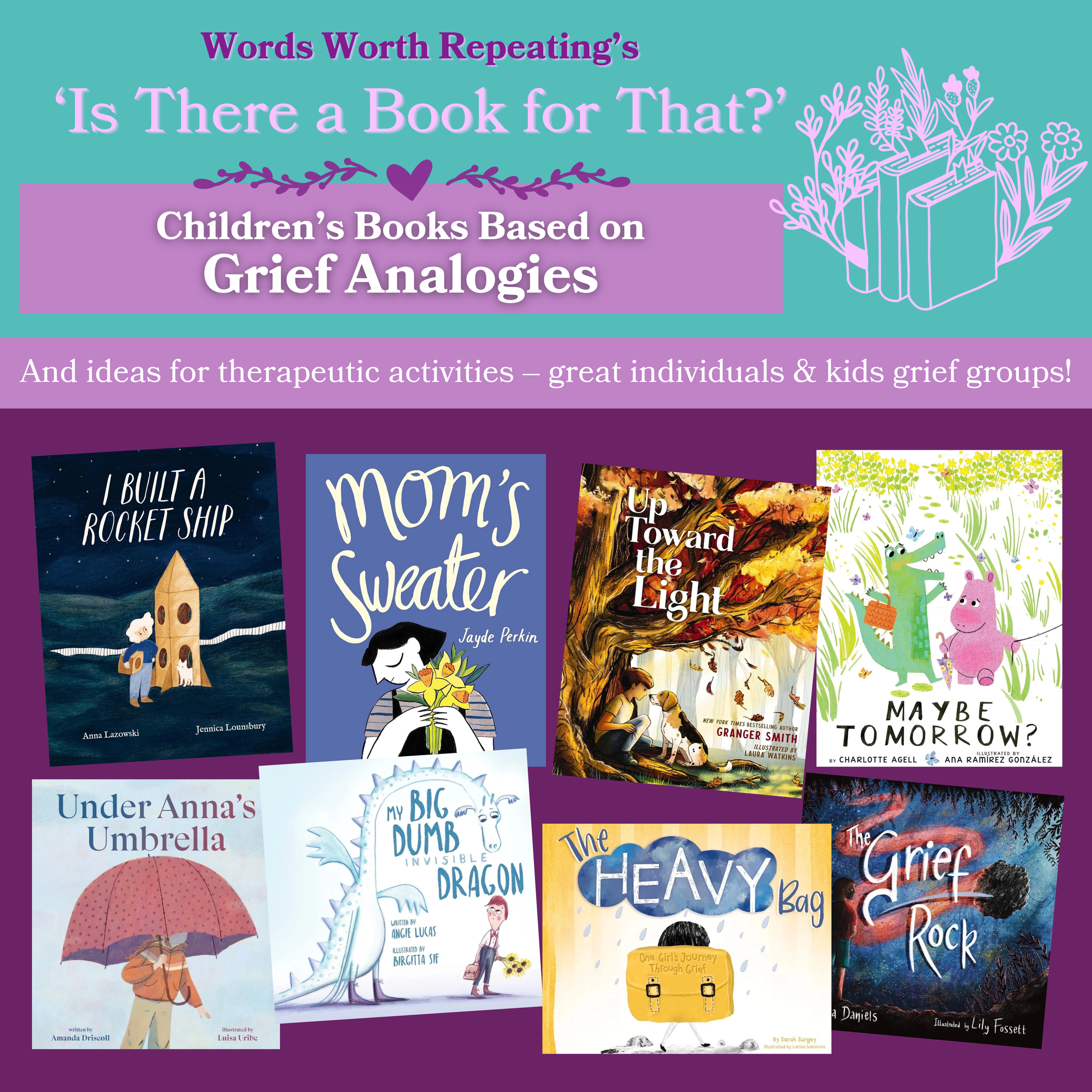
For this final week of Children’s Grief Awareness Month, I am sharing some books that use analogies to help kids understand grief. I do not recommend these books on their own. Without saying the words dead or died and explaining what that means, kids can be confused by the use of analogy. That being said, once a child has clear understanding of what happened, an analogy can help kids relate and build an understanding of what they are feeling.
For the first time in the history of the ‘Is There a Book for That?’ blog, I am also suggesting activities that can compliment the books and help kids express what they are feeling or relate to the analogy. I hope you find it helpful and you find ways to adapt it to the children in your life.
I Built a Rocket Ship by Anna Lazowski
This book talks about a young girl who is building a rocket ship to help her feel closer to her grandmother. The book says “You said that when you were gone, I’d still feel you near me, but you feel as far away as the stars”. The book plays with the analogy of wanting to get closer to people who are gone and the idea that a rocket ship will bring her to the stars which is hypothetically closer to the grandma, but she also fills the cardboard rocket ship with all sorts of things that remind her of her grandmother – her grandma’s blanket, things they did together, foods she liked, etc. In the end, her dad brings out her grandma’s lasagna to eat in the rocket, and they paint the rocket her favorite color so she will recognize it in the sky.
https://link.amazon/B08nPfUgw
Laura’s Activity Ideas: I love the idea of reading this book with kids and then having them draw the rockets that will bring them closer to their loved one. It could just be their favorite color and filled with all sorts of things that make them feel close or maybe different parts are made of different things that help them feel close. The use of imagination, remembering, and talking about missing the person makes it a great activity for grieving children.
Maybe Tomorrow? By Charlotte Agell
This book does not speak about death specifically, but instead the story of two animals, a hippo who drags around a big heavy black box and a crocodile who floats around on a cloud of butterflies. The crocodile invites the hippo on a picnic, but the hippo just wants to sit on her box. She doesn’t like the box, but she also can’t see any other option. The crocodile stays with her. He encourages to let something out of the box or to talk about it, but he doesn’t push when she doesn’t know how. Eventually they go to the beach and the box starts getting lighter and some of the butterflies fly away, the changes don’t change who they are or get rid of the box forever, but they are finally ready to go on the picnic. This book is a great example of how to be a good friend to a griever or anyone going through something hard. Great for classrooms or home libraries. This book is appropriate for young children through early elementary aged kids.
https://link.amazon/B09WTitMi
Laura’s Activity Ideas: If using this book in a grief group you could accompany the book with an obstacle course. Have kids complete the obstacle course carrying a box. Then have them complete it in teams where they can pass the box to each other so that they can accomplish the task without holding the box. Accompany the activity with finding people that will walk with you in your grief. The grief won’t go away, but it might be easier to navigate.
Up Toward the Light by Granger Smith
This book shows a boy who is looking for the tallest tree in the forest because his grandfather told him to do so. When he gets there he talks to the tree. He learns about his roots and his growth. The boy points out that he isn’t that special and that other trees in other forests are even taller. The tree takes it in stride. The tree and the boy then talk about his falling leaves and how they make room for new leaves and a new season. The boy learns that his grandfather actually planted and protected this tree when it was young. Much like the boy, the tree is thriving because of the grandfather. The tree compares his leaves to tears and encourages the boy to cry and to feel sad because it will help him find the “new season” after the tears. The tree also points out that it is important to grow toward “the light” and not toward the grandfather. That is what the grandfather would want even though they both love and care for him. This forest wisdom and analogy might need to be explained further to small children, but it will likely resonate with older elementary school kids and anyone older.
https://link.amazon/B0bhWmzF5
Laura’s Activity Ideas: This book would be a beautiful gift for a grieving adult or to be read with a child. This book could also accompany a memorial tree planting. I can see it being a special memorial gift for any age, great for every grief library, and for a fall grief group read aloud.
My Big Dumb Invisible Dragon by Angie Lucas
This book is a story about a boy who has an invisible dragon show up the day his mom unexpectedly dies. The book affects him differently on different days, and there isn’t anything he can do to get rid of it. He thinks it's why people treat him differently, but people can’t see his dragon. Eventually with time, he goes some days without his dragon and his dragon shrinks in size. This book is a good conversation starter for kids who have experienced loss. It would be good for grief groups and grief libraries.
https://link.amazon/B0bke5J45
Laura’s Activity Idea: It could be interesting to have kids draw their grief dragon with different aspects of grief that it causes in them. Some kids will take off and have lots of ideas. Others might benefit from being walked through different aspects.
Mom’s Sweater by Jayde Perkin
In this book, a young girl experiences her mom’s death. The book says she’s gone, but it never uses the words dead or died. An adult reader may need to clarify for young children. The book talks about feeling tired and time feeling blurry as the girl and her father go through the funeral and the initial days of grief and loss. It shares things she hears others say, different feelings (physical and mental) she has, having a hard time concentrating, etc. It doesn’t matter how kind people are. She still feels lonely and left out. Then she finds her mom’s sweater. She loves wearing it. It smells like her, but overtime it starts to smell like the girl and needs a good wash. Her dad then teaches her the analogy that the girl’s grief is like the sweater. It will not shrink, but eventually the girl’s world will grow so that it doesn’t feel so big. Over time, she doesn’t have to wear the sweater every day, but she likes to know it is there.
https://link.amazon/B070jPUwg
Laura Activity Idea: This is a metaphor that I have found meaningful for families before. It can be hard to grasp how time can help. The idea of grief shrinking can make kids feel like their feelings for the person or their memories will shrink. This metaphor can help them understand how it feels to continue life without a special loved one. In grief therapy or grief groups could share stories about an item that helps them feel connected to their loved one. Groups could also explore the idea of having kids bring a t-shirt or onesie of the loved ones to be repurposed. Kids could create pillows by sewing the holes shut and filling with stuffing… then forever having a pillow that reminds them of their loved one that they can hug as often as they wish.
Under Anna’s Umbrella by Amanda Driscoll
This book uses the analogy of an umbrella for a child’s grief. The book shows her at a funeral with the umbrella (it is pouring). The book states that she isn’t comfortable without the umbrella from then on… at school, at dance class, at the dinner table, etc. Her friends and family notice it, but there is nothing they can do to get her to drop it. Finally, in a new rain storm, a friend joins her under it. They connect and play, and Anna finds that she no longer needs it. This analogy makes sense and the visual is right, but I think some family or grief group conversations could be helpful in connecting with how to join someone under their umbrella or how to make space for someone to join you, might be the next important step. Good for elementary-aged kids.
https://link.amazon/B0iSpBGWq
Laura’s Activity Idea: Again, this could be an interesting processing activity. Give kids a sheet with an umbrella on it. Have them draw things on the umbrella that they think about or worry about or have them use colors that symbolize feelings or their person. Then have them draw themselves and other people that are with them through the hard feelings and thoughts. You could also develop an activity where kids have to try to get through an obstacle course while holding an umbrella. Then have them team up and share the umbrella. Is it easier when they can pass it back and forth?
The Grief Rock by Natasha Daniels
This book was written by a therapist and widow who used the analogy of a grief rock to support her children after the loss of her husband. The book is simply-worded. It explains the analogy and how the grief feelings are like carrying a rock with you throughout your day including people avoiding you when they see you. I appreciate that in the book the rock never changes or shrinks, instead the person accepts that it is a part of their life. This makes it easier to navigate, and they learn that the rock is full of love, the basis of grief. If you are looking for a simple book to help you talk about how grief feels and common experiences that grievers may have, this book could be helpful. Good for elementary school aged kids.
https://link.amazon/B03PEUAxr
Laura Activity Idea: Kids can paint rocks in honor of their person. They can keep them in their room or yard, or they can spread them at local parks for people to find. Make sure to spray the rocks that will go outside with a clear protectant.
The Heavy Bag: One Girl’s Journey Through Grief by Sarah Surgey
In this book, a young girls’ grandfather dies. After his death, the girl takes all of the special things that they shared and puts them in a bag. Then she goes on a walk along the path they used to take. She meets people along the way that ask about her heavy bag. She shares different items and their associated feelings of loneliness, having unfinished plans, and thinking about the “what ifs” with them. Slowly, her bag gets lighter. They each say “I’m happy you decided to talk. Let me hold this for you and lighten your load. You are not alone as you walk this road.” Eventually, she still has items in the bag, but they are light memories that feel good.
https://link.amazon/B0aNE2EZn
Laura’s Activity Idea: If reading this with a child or group of children, I would consider helping them either sew or decorate a bag. You could have them draw and design the bag on paper if you don’t have “bag” supplies. The design could be inspired by the relationship between the child and their loved one. Then, encourage them to fill the bag with memories, feelings, and thoughts that you have about the person who died (written on slips of paper). Lastly, talk about writing things down and putting things in the bag if they come up and don’t have someone to share it with. Then, encourage them to list people that they can trust with some of this. If it feels right, kids could take the opportunity to share some of their feelings or memories that they feel ready to talk about.
As always, I do make a small commission on purchases made through the links which help me be able to spend hours each week finding you all of the good books. I also fully support finding these books at your local library or bookstore.
